 y.layout.hierarchic.BFSLayerer
|
Search this API | ||||||||
| PREV CLASS NEXT CLASS | FRAMES NO FRAMES | ||||||||
| SUMMARY: NESTED | FIELD | CONSTR | METHOD | DETAIL: FIELD | CONSTR | METHOD | ||||||||
java.lang.Object
public class BFSLayerer
BFSLayerer uses a breadth first search for assigning layers to the nodes.
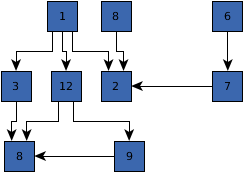
The nodes of the first layer can be freely selected (see CORE_NODES). The nodes that belong to a subsequent
layer are determined as follows: Add all yet unassigned nodes to the new layer that are connected to nodes
already assigned. As a consequence, all connected nodes will be at most one layer apart. Also, edges between nodes
that belong to the same layer are possible.
IncrementalHierarchicLayouter as well as HierarchicLayouter and
HierarchicGroupLayouter.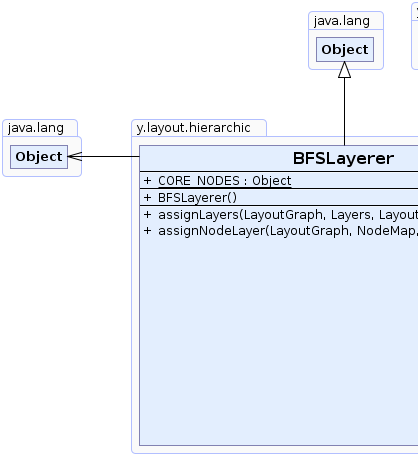 |
 |
| Field Summary | |
|---|---|
static java.lang.Object |
CORE_NODES
A DataProvider key for identifying the core nodes of the BFS layering.
|
| Constructor Summary | |
|---|---|
BFSLayerer()
Creates an instance of BFSLayerer. |
|
| Method Summary | |
|---|---|
void |
assignLayers(LayoutGraph graph,
             Layers layers,
             LayoutDataProvider ldp)
Assigns all nodes of the graph to layers and adds them to the Layers instance. |
int |
assignNodeLayer(LayoutGraph graph,
                NodeMap layerID,
                EdgeList reversedEdges)
Assigns the nodes of the graph to layers. |
| Methods inherited from class java.lang.Object |
|---|
clone, equals, finalize, getClass, hashCode, notify, notifyAll, toString, wait, wait, wait |
| Field Detail |
|---|
public static final java.lang.Object CORE_NODES
DataProvider key for identifying the core nodes of the BFS layering.
The DataProvider registered with this key should provide boolean values for the nodes of the graph.
The boolean value determines whether or not a node is to be placed in the first layer. If there are no nodes marked
as core nodes, then nodes with in-degree 0 are considered to be the core nodes.
| Constructor Detail |
|---|
public BFSLayerer()
BFSLayerer.
| Method Detail |
|---|
public int assignNodeLayer(LayoutGraph graph,
                           NodeMap layerID,
                           EdgeList reversedEdges)
(v,w) in E: layer(v) < layer(w).graph - the given graphlayerID - the NodeMap that will be filled by the layout algorithm and returns the zero-based index
of the layer to which each node belongsreversedEdges - an EdgeList containing the edges which had been reversed
public void assignLayers(LayoutGraph graph,
                         Layers layers,
                         LayoutDataProvider ldp)
Layers instance.
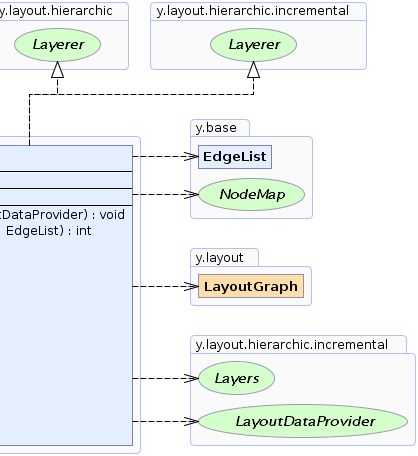
assignLayers in interface Layerergraph - the input graphlayers - the Layers instance that will be filled with the results of the calculationldp - the LayoutDataProvider used for query information about the nodes and edgesLayers.insert(byte, int),
Layer.add(y.base.Node)
|
© Copyright 2000-2022, yWorks GmbH. All rights reserved. |
||||||||
| PREV CLASS NEXT CLASS | FRAMES NO FRAMES | ||||||||
| SUMMARY: NESTED | FIELD | CONSTR | METHOD | DETAIL: FIELD | CONSTR | METHOD | ||||||||